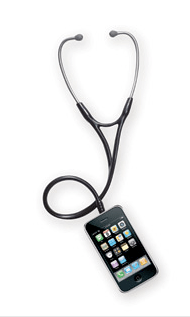
Some of those cool convergence Star Trek moments are beginning to happen. Your iPhone will soon be a means to keep tabs on your glucose level, blood pressure or other health concerns.
Consumers’ desire for this kind of information and the ease of using their trusty iPhone to get it makes for a huge opportunity for app builders. I think I’m going to stop writing and go brainstorm my own right now!
I see two potential pitfalls: 1) the FDA regulates all medical devices so where does that definition begin and 2) what is the specialty / agenda of the builder?
In my experience, the Big Pharma environs tend to have an impossible time thinking and applying consumer-centric programs beyond the problem or disease they treat. A women with diabetes thinks about it in the context of her entire life – her overall health and other ailments, her job and the insurance benefits it does or doesn’t provide, balancing her kids’ needs, her elderly auntie who has it too. And the drug makers are just not set-up culturally (or legally) to embrace this view of her world.
I am not maligning the creativity or intent of some of the very smart people who work in the industry. However, just the thought of the potential approval process for a good app that thinks about a disease from a patient perspective instead of a “persistence enhancement” one by Pharma in-house legal and doctor-review panels makes my head hurt. Ugh, I think my stomach is turning too.
In my opinion, the best apps will be made outside the industry by those with a consumer health advocacy background.
Some of the highlights from the Ad Age article:
“This is a seminal moment for the pharmaceutical industry,” said Tim Gee, principle of Beaverton, Ore.-based Medical Connectivity Consulting. “The trend to incorporate more medical devices into consumer electronics is going to explode.”
Among the existing 35,000 applications for the iPhone — paid and free — there already exist more than 500 medical apps, mainly used by health professionals for things such as checking normal lab values.
California-based research firm O’Reilly Media said medical apps are the third-fastest-growing category for Apple, with a 133% jump in April compared with the previous three months collectively. Only games and travel apps were downloaded more.
[With its latest generation, due out this summer] Apple clearly targeted the industry and showed how pharmaceutical manufacturers might use the iPhone’s new external-accessories application to do things such as hook up a blood-pressure cuff to the iPhone and take someone’s pressure.
“Apple contacted us about three weeks before their presentation and asked us if we were interested in putting something together based on their new software,” said Dave Detmers, director-communications for Milpitas, Calif.-based LifeScan. “We were very interested in this. We see a lot of potential in terms of being able to add these types of applications on these devices, and Apple sees an opportunity for broader applications in the medical field.”
Johnson & Johnson, as well as third-party developers, [will be making and marketing] medical applications for the phones, such a feature that will allow patients to verify what procedures their insurance covers.
“A lot of what’s driving this is we are moving to a state of cost shifting in health care,” said Loreen Babcock, CEO of Omnicom Group’s Unit 7, a relationship-marketing agency. “As more and more costs shift to consumers, as co-pays rise, as premiums rise, more and more is being forced on the consumer. As you see this over time, now consumers need to become aware of what their options are. When insurance pays the majority, you may not feel inclined to search out alternatives. When the consumer is paying the majority, they’re going to look elsewhere, and these applications are incredible. They’re creating more of an ongoing social engagement or connection between physicians and patients, which is exactly what pharma is looking for in social media.”
One potential roadblock is the Food and Drug Administration [which did not respond to a query by press time:] At what point does the iPhone or any other smartphone turn from a communications device to a medical device, and therefore fall under FDA regulations?

 Born Curious
Recent Comments