A fun Friday afternoon tidbit, courtesy of Euromonitor International (with my links added in if you’d care to know more of the story):
The concept of customer loyalty marketing has been around for many years, but is only since the mid-1990s that it has expanded from merely being a model for conducting business to becoming a vehicle for marketing and advertising.
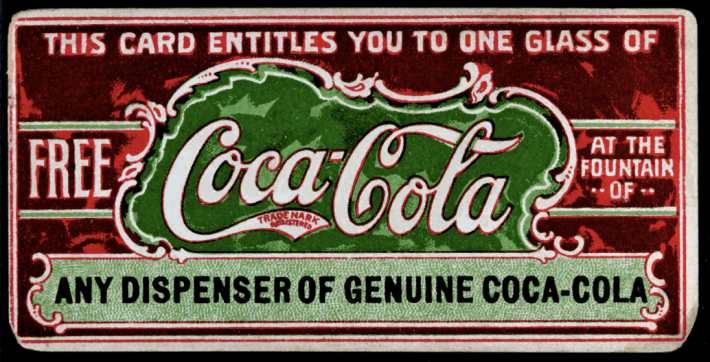
Couponing by manufacturers dates back as far as 1887, when Coca-Cola Company distributed complimentary coupons for Coca-Cola in the US, via the post or magazines. The company gave soda fountains free syrup to cover the cost of the free drinks. It is estimated that between 1894 and 1913, some 8.5 million free drinks were claimed, which enabled the brand to reach all states.
One of the key pioneers of loyalty schemes was the US kitchenware company Betty Crocker, which issued coupons that could be redeemed for free products as early as 1929. In 1937, coupons were printed on the outside of packets, allowing consumers to save points towards a reward from the Betty Crocker Catalog. The programme continued until 2006, when it was announced that the Betty Crocker Catalog was ceasing trading.
S&H Green Stamps was another retail reward scheme which was very popular in the US from the 1930s through to the 1980s. Typically, as a consumer shopped at various grocery stores, they would receive a set number of Green Stamps that could be pasted into booklets and redeemed for prizes.
In the UK, Jack Cohen, the Tesco founder, signed up to Green Shield Stamps in 1963. In 1977, Tesco ended the Green Shield Stamps programme in order to fund a new price-cuts policy. In 1995, Tesco introduced Clubcard, now the UK’s most popular loyalty scheme, while in 2000, Green Shield Stamps was relaunched as greenpoints.com.
In May 1981, American Airlines launched the first major airline loyalty marketing scheme, with its AAdvantage frequent flyer programme. This was the first programme to reward “frequent flyers” with reward miles that could be accumulated and later redeemed for free travel, and now has over 50 million active members. The success of the programme promoted many other travel companies to launch similar programmes. Later in 1981, similar schemes were launched by United (Mileage Plus) and Delta (SkyMiles), and in 1982 by British Airways (Executive Club).

 Born Curious
Recent Comments