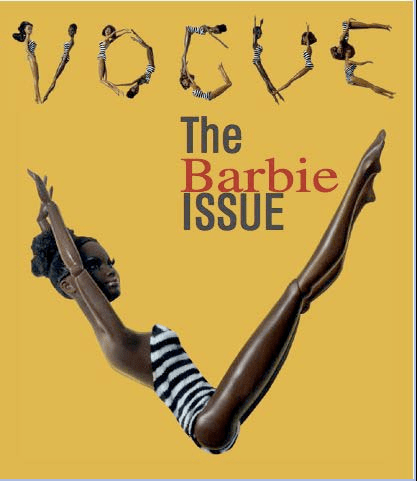
I picked up the July Vogue Italia at the newsstand yesterday, excited to see the Barbie anniversary tribute to Vogue Italia‘s The Black Issue (get that? good)
I went and pulled out the 2008 Black Issue and leafed through it once again and thought about how incredibly ridiculous it is that that issue was (is) such a big deal.
I also thought about all the hours and how many people it took to get that Barbie book together. (It’s page after page of Black Barbie dolls dressed in the most gorgeous one-offs around, staged in numerous editorial shoots. The hats alone! Here are some images that have been posted.) It is a creative labor of love that some will shake their heads in disbelief when I assert – “this kind of project has a huge influence on popular culture. It really matters.”
You know, the Cerulean blue speech from The Devil Wears Prada.
Anyway, I started searching for commentary, articles, numbers, any kind of information on the impact of the 2008 issue. It certainly hasn’t shamed Anna Wintour and Co. into any meaningful action but I do see several of the new faces of that issue all over the place now, particularly Chanel Iman, Jourdan Dunn and Arlenis Sosa.
While searching, I came across this (sadly) still appropriate lament in the forever fantastic Bitch magazine.
There have, however, been waves of wider acceptance. In the 1970s, Iman, Pat Cleveland, and Beverly Johnson—the first black woman to appear on the cover of Vogue—all catapulted onto the fashion stage. In the early-to-mid-’90s, opportunities for nonwhite models seemed to open up once again, as not only Banks and Campbell but also Karen Alexander, Tyson Beckford, Beverly Peele, Roshumba Williams, Jenny Shimizu, Veronica Webb, and Alek Wek became highly visible figures. It was a short-lived period, though, one that Webb herself explored in a 1996 Essence article, “Where Have All the Black Models Gone?” After noticing that the runways were overwhelmingly populated with very pale blonds, she took it upon herself to talk to industry insiders about the reason for this shift. Webb’s interviews with designers, photographers, and fashion-magazine editors inspired an orgy of finger-pointing, with photographers claiming that they shoot models chosen by the magazines who hire them, editors saying they tap the runway for models to appear in their magazines, and designers replying that they look to magazine pages to scout modeling talent for their collections.
The Bitch article re-counts in-depth the ‘Naomi versus Tyra’ saga (which really means “there can be only one Black girl in the show”), as the writer watched an episode of Tyra’s show where she and Naomi reconciled (sort of.)
As far back as 1994, Banks resented the comparisons between her and Campbell, as she told People in a rare comment on her supposed competitor: “Why do I have to knock Naomi out to be successful? With white models they don’t do that.” Nonetheless, Campbell … reportedly tried to force her then-agency, Elite Model Management, to choose between her and Banks; Banks decided to leave Elite for IMG in order to ease the tension.
Banks eventually quit high-fashion catwalks and photo shoots and found refuge in the mainstream gigs—like modeling for the Victoria’s Secret catalog and posing for Sports Illustrated’s swimsuit issue—that make room for more voluptuous (in modeling terms, anyway) figures like hers. This has been her official story for years—but as she revealed to Campbell on her show, “That’s only 50 percent of it.” Banks was also “tired of the comparison” and “tired of constantly hearing that I got canceled from this job…or this magazine was called and [told] not to use me.” Ultimately, Banks grew tired of walking in Campbell’s shadow, so she ceded the haute couture battle to her.

 Born Curious
Recent Comments