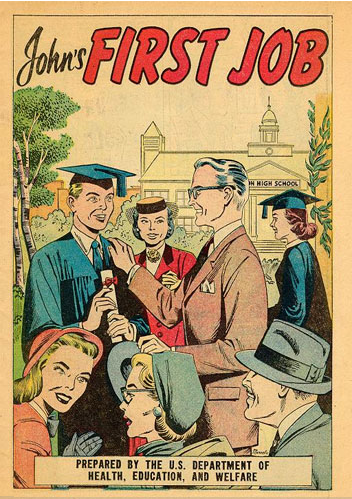
While tooling around, looking for numbers on another subject entirely, I came across this great article, bursting with stats, on the impact a bad economy has on a person’s earning potential. The full link includes many anecdotes and is worth checking out if you are so inclined.
Economic research shows that the consequences of graduating in a downturn are long-lasting. They include lower earnings, a slower climb up the occupational ladder and a widening gap between the least- and most-successful grads.
In short, luck matters. The damage can linger up to 15 years, says Lisa Kahn, a Yale School of Management economist. She used the National Longitudinal Survey of Youth, a government data base, to track wages of white men who graduated before, during and after the deep 1980s recession.
Ms. Kahn found that for each percentage-point increase in the unemployment rate, those with the misfortune to graduate during the recession earned 7% to 8% less in their first year out than comparable workers who graduated in better times. The effect persisted over many years, with recession-era grads earning 4% to 5% less by their 12th year out of college, and 2% less by their 18th year out.
The impact on wages could be just as severe this time around, says Ms. Kahn. That’s because of the depth of this recession and the possibility that the unemployment rate may approach the 10.8% level not seen since the early 1980s. The rate hit 8.9% in April, the Labor Department reported Friday.
One reason behind declining wage potential, economists say: The caliber of jobs available in a recession, and their accompanying wages, tend to suffer. High-end firms hire fewer people and drive down salaries because jobs are in such demand.
That means many graduates end up with lower-wage, lower-skill jobs at less-prestigious firms or in firms outside their field of interest. Once the economy picks up and they try for better jobs, these workers have to learn skills they should have been developing immediately out of college. In the meantime, colleagues who graduated in a better economy have already developed these skills and progressed much further.
This year, employers say they’ll hire 22% fewer college graduates than last year, according to the National Association of Colleges and Employers, an organization of career counselors. At the same time, colleges are expected to see the highest number of graduates in a decade. The average starting salary for graduates who do get jobs, meanwhile, dropped to $48,515 this spring, down 2.2% from the same time last year, according to NACE.
Marco von Wachter, a Columbia University economist, with a couple of colleagues, has looked at wage data covering 70% of all Canadians who graduated from college between 1976 and 1995, a span encompassing two recessions. His work indicates that graduates who get jobs in their fields — even low-paying jobs — are able to learn the right skills, and thus have an edge when the economy rebounds.
Mr. von Wachter also found that what recession-era graduates studied, and where they went to school, made a big difference in how quickly they caught up to workers who graduated in boom times. People who majored in fields that lead to high-paying jobs, such as chemistry, biology, physics and engineering, tended to catch up to other graduates more quickly, primarily by switching jobs during the economic recovery and landing at better firms. In contrast, says Mr. von Wachter, the wages of humanities majors at less prestigious schools were less likely to catch up to the wages of their peers who graduated in healthier times.

 Born Curious
Recent Comments